AI Isn’t Replacing Jobs — It’s Redefining Them: Deloitte’s Upskilling-First Strategy
AI Isn’t Replacing Jobs — It’s Redefining Them: Deloitte’s Upskilling-First Strategy
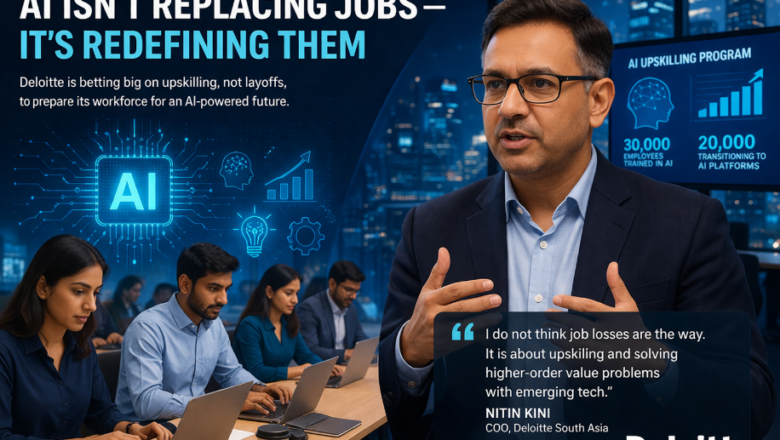
Amid growing global anxiety over artificial intelligence replacing human jobs, a contrasting perspective is emerging from industry leaders. Nitin Kini has made it clear that the real impact of AI is not about job losses, but about job transformation through upskilling.
His remarks reflect a broader shift in how leading organizations are adapting to the AI era — not by reducing workforce size, but by reinventing employee capabilities.
A Shift from Job Cuts to Capability Building
At the center of this approach is Deloitte’s ambitious hiring and training strategy in India. The company is in the process of onboarding 50,000 professionals, signaling strong confidence in the continued importance of human talent — even in an AI-driven future.
Rather than viewing AI as a replacement for employees, Deloitte is positioning it as a tool to elevate human potential. The focus is on preparing workers to handle more complex, high-value tasks that machines alone cannot manage.
Training at Scale: Preparing the Workforce for AI
The scale of Deloitte’s internal transformation is significant:
- Nearly 30,000 employees have already been trained in AI technologies
- Another 20,000 are transitioning to work on in-house AI platforms
This large-scale upskilling initiative highlights a critical reality — companies are not slowing hiring due to AI; instead, they are increasing investment in skill development.
It also signals that future employability will depend less on traditional roles and more on adaptability and continuous learning.
The Rise of “Higher-Order” Work
A key theme in Kini’s statement is the emphasis on solving “higher-order” business problems. This represents a fundamental shift in the nature of work:
- Routine and repetitive tasks are increasingly handled by AI
- Human roles are moving toward strategy, innovation, and decision-making
- Employees are expected to work alongside AI systems, not compete with them
This transition pushes the workforce up the value chain, where critical thinking and creativity become central skills.
Redefining the Future of Employment
Deloitte’s approach reflects a growing consensus across the tech and consulting industries:
- AI will reshape job roles, not eliminate them entirely
- Workforce relevance will depend on reskilling and upskilling
- Organizations that invest in people will gain a competitive advantage
In this model, AI becomes a collaborator, enhancing productivity rather than replacing human input.
future of work lies not in fewer jobs, but in better, more advanced roles
The narrative that AI will trigger widespread unemployment is being challenged by real-world strategies like Deloitte’s. By prioritizing upskilling and large-scale hiring, the company is demonstrating that the future of work lies not in fewer jobs, but in better, more advanced roles.
As businesses continue to integrate AI into their operations, the defining factor will not be whether jobs disappear — but whether the workforce is prepared to evolve alongside the technology.