The Houthi Factor: From Mountain Rebellion to Global Protagonist in the Iran-Israel War
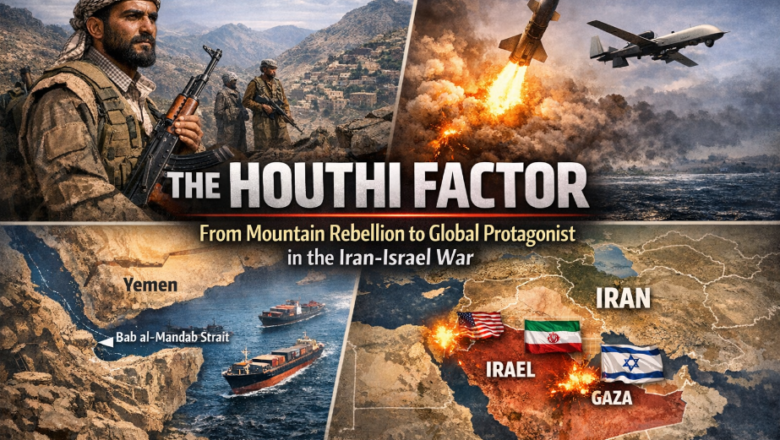
The recent direct involvement of the Houthi movement (Ansar Allah) in the conflict between Iran and Israel marks a turning point in Middle Eastern geopolitics. No longer confined to the borders of Yemen, the Houthis have transformed into a regional “wildcard” capable of striking distant targets and disrupting the global economy. To understand this shift, we must look at their deep-rooted history and their evolving “partnership of convenience” with Tehran.
- The Roots of Resistance: A Brief History
The Houthis are not a new phenomenon. Their story begins in the 1990s in northern Yemen:
- The Zaydi Revival: The movement emerged as a religious and cultural awakening for the Zaydi Shia sect, which had ruled Yemen for a thousand years before 1962 but felt marginalized by the modern state.
- The “Believing Youth”: Founded by Hussein al-Houthi, the group initially focused on education and social work. However, following the 2003 US invasion of Iraq, the movement became sharply political and anti-Western.
- The Six Wars: Between 2004 and 2010, the Houthis fought six brutal wars against the Yemeni government. Despite the death of their founder, the group grew stronger, more disciplined, and more radicalized.
- The 2014 Takeover: Exploiting the chaos of the Arab Spring, the Houthis seized the capital, Sanaa, in 2014, eventually forcing the internationally recognized government into exile and sparking a decade-long civil war.
- The Alliance with Iran: Why and How?
The relationship between the Houthis and Iran is often misunderstood. While the Houthis are not “puppets,” they are strategic partners:
- Shared Ideology: Both share a “Revolutionary Shia” outlook that opposes Western “hegemony” in the Middle East. The Houthi slogan—“God is Greatest, Death to America, Death to Israel, Curse on the Jews, Victory to Islam”—is directly modeled after Iranian revolutionary rhetoric.
- Military Transformation: Iran has provided the “know-how” for the Houthis to build an impressive arsenal. This includes:
- Toofan Ballistic Missiles: Capable of reaching targets up to 2,000 km away (including southern Israel).
- Quds Cruise Missiles: Highly accurate drones and missiles used to strike oil facilities and ships.
- Strategic Depth: For Iran, the Houthis provide a “southern front” to pressure Israel and the West without Iran having to engage in a direct, official war.
Military Strength: An Army of the People?
As of 2026, the Houthi military is no longer a rag-tag militia.
- Army Size: Estimates suggest a standing force of 200,000 to 350,000 fighters, bolstered by tribal alliances and mandatory conscription in the areas they control.
- Sea Denial: Their greatest strength lies in their proximity to the Bab al-Mandab Strait. With sea mines, anti-ship missiles, and “suicide” drone boats, they can effectively hold global trade hostage.
- The Impact on USA and Israel
The Houthi entry into the Iran-Israel war creates “adverse situations” for the West:
- Israel’s Multi-Front Challenge: Israel must now divert its world-class air defenses (like the Arrow and Iron Dome systems) to intercept threats coming from the south (Yemen), while already managing threats from the north (Hezbollah) and east (Iran).
- The US Dilemma: The US Navy has been forced into a costly “cat-and-mouse” game in the Red Sea. Intercepting a $2,000 Houthi drone with a $2 million US missile is financially unsustainable in the long term.
- Global Inflation: By threatening shipping, the Houthis drive up insurance costs and oil prices globally. If the Red Sea remains “closed” to Western ships, it adds weeks to delivery times, hitting the pockets of consumers worldwide.
What Happens if the Support for Iran Continues?
If the Houthis continue to act as Iran’s primary “long-distance hammer,” we could see:
- Direct Retaliation: Israel may be forced to strike Yemeni ports (like Hodeidah) directly, as they did in late 2024 and 2025.
- Regional Conflagration: Their actions could draw Saudi Arabia back into the war, ending the fragile 2022 truce and causing a fresh humanitarian catastrophe.
- Decapitation Strikes: The US and Israel may target the Houthi high command to break their organizational structure.
Motivated, well-armed non-state actor :-
The Houthis have proven that a motivated, well-armed non-state actor can disrupt the plans of global superpowers. Their history of resilience suggests they will not back down easily. For world leaders, the challenge is no longer just “Yemen’s civil war”—it is a battle for the stability of the global order.