US Bolsters Middle East Presence as Trump Eyes Iran’s Key Oil Hub
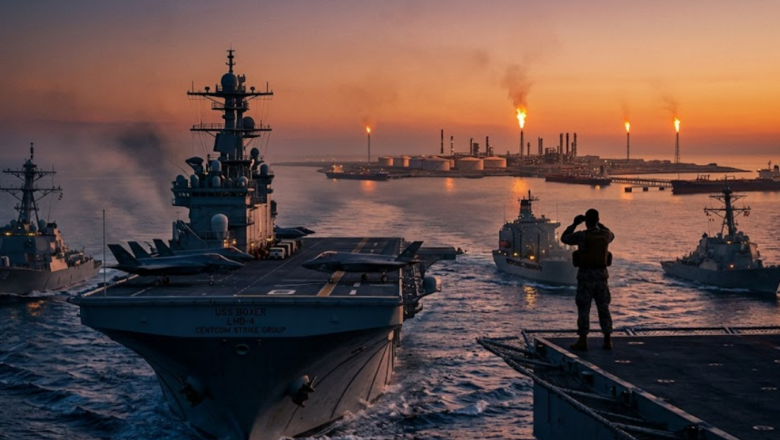
DUBAI – The United States military has significantly ramped up its presence in the Middle East, deploying thousands of additional sailors and marines to the region as tensions with Iran reach a critical flashpoint. The surge comes amid high-level discussions in Washington regarding the potential seizure of Iran’s primary energy infrastructure.
Naval Reinforcements Arrive
U.S. Central Command (CENTCOM) confirmed this week that thousands of personnel have arrived in the region aboard the USS Tripoli. These forces are tasked with operating across a strategic corridor that includes the Red Sea, the Gulf of Oman, and the Arabian Sea.
Further reinforcements are reportedly on the way. Media outlets indicate that the USS Boxer Amphibious Ready Group—which includes an assault ship, a transport dock, and a dock landing ship—is currently steaming toward the region. This brings the total estimated U.S. troop count in the Middle East to over 50,000, scattered across key bases in Saudi Arabia, Kuwait, Bahrain, Qatar, the UAE, and Oman.
The “Kharg Island” Option
The military buildup coincides with provocative statements from President Donald Trump, who revealed he is considering a move to seize Kharg Island. As Iran’s primary oil hub, the island processes approximately 90% of the country’s crude oil exports.
While Trump noted that “a deal with Iran could be made soon,” his comments regarding the island have fueled international speculation about a possible ground invasion. Analysts suggest that controlling Kharg Island would effectively allow the U.S. to “take the oil,” a move Trump has previously favored in other regional contexts.
Securing the Strait of Hormuz
Beyond the threat of invasion, the expanded naval presence serves a vital economic purpose: keeping the Strait of Hormuz operational. At its narrowest point, the waterway is only 33 kilometers wide, making it highly vulnerable to disruption.
The U.S. vessels now entering the region are specifically equipped to counter various types of Iranian attacks, ensuring that global oil transit remains uninterrupted.
Tehran Issues “Rain of Fire” Warning
The response from Tehran has been swift and combative. Iran’s parliamentary speaker has publically accused Washington of plotting a ground attack, warning that Iranian forces are prepared to “rain fire” upon U.S. troops should they attempt an invasion.
As both nations trade threats, the international community remains on edge, watching whether the massive military deployment leads to a diplomatic breakthrough or the start of a major regional conflict.