Vietnam at a Crossroads: Ambitious 2026 Reforms Clash with the Heavy Price of Dissent
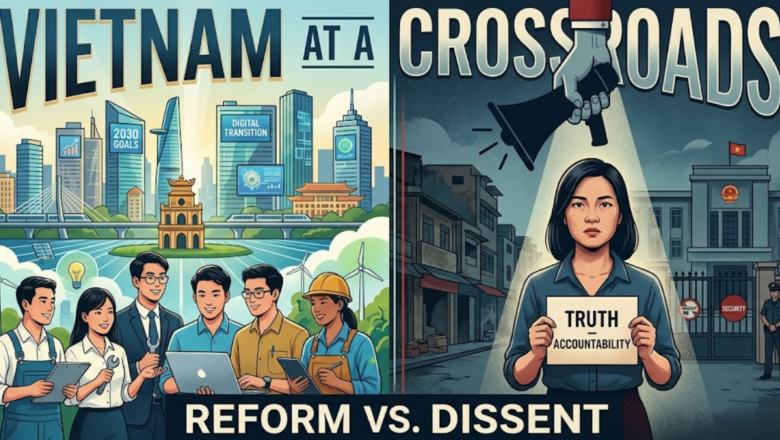
As 2026 unfolds, Vietnam finds itself navigating a critical juncture. On the surface, the nation is racing toward modernization, marked by sweeping political restructuring, high-tech governance, and ambitious economic milestones. Yet, beneath the veneer of progress showcased at the 14th National Party Congress, a starkly different narrative is being broadcast on the international stage—one that highlights the enduring, often perilous struggle against systemic corruption and the suppression of democratic voices.
The Grand Vision: Elections and Economic Ambition
Early 2026 has been defined by major political maneuvers for the ruling Communist Party of Vietnam (CPV). At the 14th National Party Congress in January—coinciding with the 40th anniversary of the transformative Đổi Mới reforms—the state laid out aggressive long-term goals. The objective is clear: elevate Vietnam to a modern, high-middle-income nation by 2030, and a fully developed, high-income country by 2045.
To steer this vision, To Lam was confirmed for a second term as Party General Secretary, cementing his authority over the country’s political trajectory. This leadership continuity was further reinforced during the March 2026 General Elections. With nearly 79 million eligible voters casting ballots for the 16th National Assembly, the elections were tightly controlled, with approximately 93% of the candidates drawn directly from the CPV.
Simultaneously, the government has launched drastic institutional reforms, implementing a new two-tier local governance model and cutting 145,000 administrative positions to streamline the state apparatus and save billions.
The Digital Double-Edged Sword
Vietnam’s drive for modernity is heavily intertwined with technological advancement. In 2026, the state accelerated its digital transition, from mandating digital land registries to deploying thousands of AI-powered surveillance cameras in major cities like Hanoi. While officially aimed at monitoring traffic and public order, the rapid expansion of AI and digital surveillance infrastructure has raised quiet alarms among international observers regarding privacy and state control.
The Price of Truth: Voices from Geneva
While domestic media highlights economic milestones and streamlined governance, a vastly different reality for Vietnamese citizens was recently spotlighted at the Geneva Summit for Human Rights and Democracy in February 2026.
The powerful testimony of Hue Nhu, a Vietnamese pro-democracy and anti-corruption activist, served as a chilling counter-narrative to the state’s official success story. A former political prisoner, Nhu took the global stage to expose the deeply entrenched corruption that plagues the nation’s political and economic systems.
Her address stripped away the rhetoric of reform to reveal the severe human cost of demanding transparency in Vietnam. Nhu detailed the grim realities faced by those who dare to challenge the status quo, outlining the systematic harassment, imprisonment, and silencing of activists who expose graft among the political elite. Her testimony underscored a stark paradox: while the Vietnamese government publicly campaigns against corruption at the highest levels, grassroots activists who independently expose these same crimes are routinely treated as enemies of the state.
A Nation in Duality
Vietnam in 2026 is a study in contrasts. It is an emerging powerhouse aggressively securing its energy reserves, pivoting to green technology, and attracting global investment. Yet, as Hue Nhu’s testimony in Geneva vividly illustrates, it remains a nation where the fundamental rights to speak, critique, and demand accountability are heavily restricted.
As the newly elected National Assembly convenes to formalize the next phase of Vietnam’s development, the international community watches closely. The question remains whether Vietnam’s march toward a high-income, modernized future can eventually make room for the transparency and human rights its citizens are risking their freedom to demand.