US Weighs Ground Assault on Iran’s ‘Crown Jewel’ as Tensions Escalate
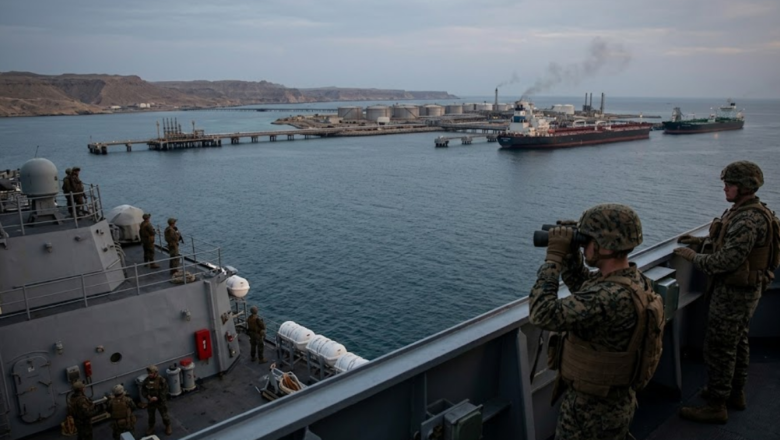
US President Donald Trump has signaled that the United States is weighing a potential ground operation to seize Kharg Island, a highly strategic Iranian outpost that serves as the economic lifeline for the Islamic Republic.
The threats mark a significant escalation in the ongoing conflict, raising the specter of a complex amphibious assault and a broader regional war that could send global energy markets into a tailspin.
“Maybe We Take Kharg Island”
In a recent interview with the Financial Times, President Trump openly discussed the possibility of an occupation, though he acknowledged the logistical burden it would entail.
“Maybe we take Kharg Island, maybe we don’t. We have a lot of options,” Trump stated. “It would also mean we had to be there for a while… I don’t think they have any defence. We could take it very easily.”
The rhetoric follows a devastating US airstrike on March 13, in which US Central Command (CENTCOM) struck over 90 military targets on the island. Trump characterized the operation as one of the most powerful bombing raids in Middle Eastern history, claiming US forces had “totally obliterated” every military installation on Iran’s “crown jewel.”
Targeted sites included naval mine storage facilities, missile bunkers, and an airport control tower. However, the US intentionally held back from targeting the island’s vast oil infrastructure.
The Strategic Value of Kharg Island
Located just 15 nautical miles (24 km) off the Iranian coast, the rocky outcrop is essential to Tehran’s economy.
- The Oil Artery: Roughly 90% of Iran’s crude oil is transported through pipelines from the mainland to Kharg Island’s terminals.
- Deep Water Access: Unlike the shallow coastal waters of the Iranian mainland, Kharg Island’s long jetties drop into deep waters, allowing Very Large Crude Carriers (VLCCs)—capable of holding up to 2 million barrels of oil—to dock and load.
- Economic Lifeline: Taking the island would effectively sever the primary revenue stream for the Islamic Revolutionary Guard Corps (IRGC), severely hampering its ability to fund its war efforts.
Why the Oil Infrastructure Was Spared
Despite the heavy bombardment, the island’s oil terminals remain operational. According to Ehsan Jahanian, a political deputy for Iran’s Bushehr province, oil exports are continuing uninterrupted.
Destroying the energy grid would present massive risks. Analysts note that leveling the pipelines would not only send global oil prices skyrocketing but would also risk severe Iranian retaliation. A month into the war, Iran maintains the capacity to launch swarms of explosive drones at neighboring Gulf Arab states and vital civilian infrastructure, such as desalination plants.
President Trump noted the US is keeping the threat in its back pocket as leverage. “We can do that on five minutes’ notice. It’ll be over,” Trump said on March 16. “Just one simple word, and the pipes will be gone too. But it’ll take a long time to rebuild that.”
Troop Movements and Iranian Defenses
Speculation of an imminent ground invasion has been fueled by recent military maneuvers. On Saturday, CENTCOM confirmed the arrival of an additional 3,500 US Marines and sailors in the Middle East, spearheaded by the amphibious assault ship USS Tripoli.
While the Pentagon and White House have declined to comment on specific deployment plans, sources indicate detailed preparations for a ground incursion have been drawn up.
Any attempt to seize the island, however, would be a daunting military challenge. According to Aaron Maclean, a national security analyst, an amphibious or airborne landing would require moving a large force across heavily contested territory.
Iran has spent recent weeks turning the island into a fortress:
- Reinforced Personnel: Tehran has flooded the island with additional troops and shoulder-fired surface-to-air missiles.
- Booby-Trapped Waters: Iranian forces have laid anti-personnel and anti-armor mines in the waters surrounding the island.
- Threats of Retaliation: Iranian parliament speaker Mohammad Bagher Ghalibaf has warned that his forces are “waiting for American soldiers” and will “rain fire” on any invading troops. Furthermore, Iranian military officials have threatened to expand attacks on commercial shipping in the Red Sea if a ground invasion occurs.
As the USS Tripoli moves into position, the US finds itself at a critical juncture: executing a knockout blow to Iran’s economy, or risking a grueling occupation and a massive disruption to the global oil supply.