High-Stakes Extraction: Inside the Daring US Rescue Mission Deep in Iranian Territory
Here is an article tailored for the “World” page of a news outlet, based on the details of the downed pilot and the subsequent rescue operation:
*
By thenews9.org
In a dramatic escalation of tensions in the Middle East, a complex and highly dangerous US military search-and-rescue operation unfolded deep inside Iran this past week. The mission, triggered by the unprecedented shootdown of an American fighter jet, has resulted in the successful extraction of a US airman, but not without significant material losses and fiercely conflicting narratives between Washington and Tehran.
A Rare Shootdown
The ordeal began on Friday when a US F-15E Strike Eagle, carrying a pilot and a weapons systems officer, was shot down by enemy fire over southern Iran. This marks the first time in over two decades that an American fighter jet has been brought down by hostile fire.
While the pilot was swiftly rescued the same day, the second crew member found himself stranded in the rugged terrain of hostile territory. Armed with only a handgun, the airman initiated strict survival protocols. Fearing his beacon could be intercepted by Iranian forces—or the armed civilians actively hunting him for a £50,000 bounty—he took refuge in a mountain crevice, kicking off a desperate race against time.
The Intelligence War
The rescue was as much an intelligence operation as a military one. According to US officials, the CIA played a pivotal role in locating the missing officer. The agency continuously tracked his position and reportedly launched a sophisticated deception campaign, spreading misinformation within Iran that the airman had already been found, in order to throw pursuers off his trail.
Under the cover of darkness—a tactical advantage favored by US special forces—the extraction was set into motion. “Darkness is better for our people because they’re used to operating at night,” noted retired US Navy Admiral William Fallon, emphasizing the critical timing of the mission.
Firepower and Extraction
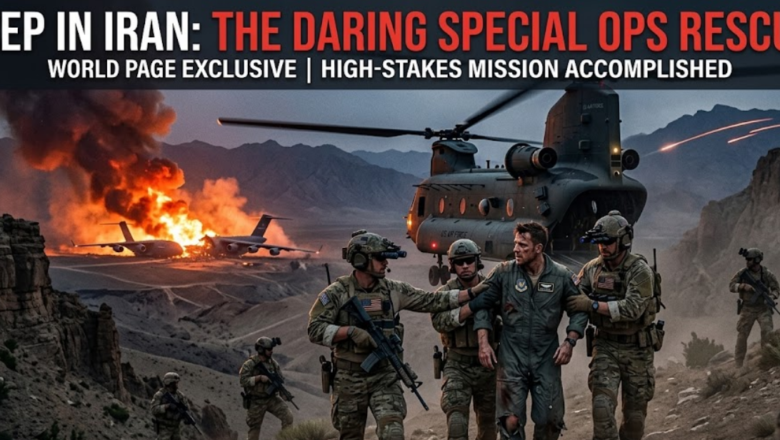
President Donald Trump confirmed the successful rescue of the “seriously wounded” officer, stating he was extracted from “deep inside the mountains of Iran” by a large contingent of special forces backed by heavily armed aircraft. As the rescue teams closed in on the stranded airman’s location, US forces reportedly used bombs and weapons fire to create a defensive perimeter and keep Iranian troops at bay. By midnight, the airman was safely evacuated to Kuwait for medical treatment.
Conflicting Narratives and the Cost of Rescue
While the US celebrates the return of its service member, adhering to its military ethos of “never leaving an American warfighter behind,” the operation came at a heavy cost, sparking a war of words.
Iran’s military command dismissed the operation as a “disgraceful defeat.” Iranian state media and military spokespeople claimed they foiled a deception mission at an abandoned airport south of Isfahan, asserting they destroyed two US C-130 transport planes, two Black Hawk helicopters, and shot down a US drone involved in the search.
The US military acknowledges that aircraft were lost during the mission, but the narrative differs sharply. US media reports indicate that two transport aircraft, unable to take off from a remote Iranian base, were intentionally destroyed by American forces to prevent them from falling into enemy hands. Additional aircraft had to be dispatched to retrieve the extraction teams. Visual evidence from the region, including satellite imagery of smoldering wreckage approximately 50 kilometers southeast of Isfahan, corroborates that aircraft were indeed destroyed during the chaotic operation.
Geopolitical Fallout
The loss of an F-15E and several rescue aircraft deep inside Iran highlights both the immense reach of the US military and the severe limitations and risks of operating within heavily defended, hostile airspace. As General Frank McKenzie, a former commander of US Central Command, noted regarding the lost aircraft: “You take that loss any day in a situation like this.”
While the airman is safe, the geopolitical reverberations of American special forces clashing with Iranian military elements on Iranian soil are likely to be felt across the region for months to come.