The Lifelong Impact of IVF: Advantages, Risks, and the Future Health of Assisted Reproductive Technology Babies
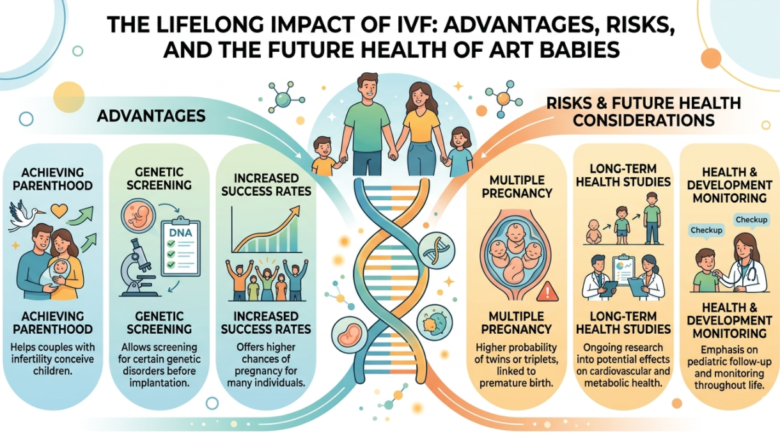
The Lifelong Impact of IVF: Advantages, Risks, and the Future Health of Assisted Reproductive Technology Babies
By the Health Desk thenews9.org
Since the birth of the first “test-tube baby” in 1978, In Vitro Fertilization (IVF) and other Assisted Reproductive Technologies (ART) have fundamentally transformed modern medicine, bringing over 8 million children into the world. While IVF is widely celebrated as a safe and effective medical miracle for struggling parents, the scientific and medical communities continue to rigorously study the long-term health outcomes of children conceived in a laboratory environment.
Relying on a matrix of established medical literature, epidemiological data, and longitudinal studies, this article breaks down the advantages, disadvantages, and potential future health considerations associated with IVF.
The Factual Matrix: Advantages of IVF
The primary benefit of IVF is straightforward: it provides a pathway to parenthood for individuals and couples who would otherwise be unable to conceive. However, the medical advantages extend beyond basic conception.
- Overcoming Severe Infertility: IVF bypasses structural issues such as blocked fallopian tubes, severe endometriosis, or male-factor infertility (often treated with ICSI, a specialized form of IVF).
- Preimplantation Genetic Testing (PGT): One of the most profound advantages of modern IVF is the ability to screen embryos for genetic abnormalities before transfer. This significantly reduces the risk of passing on inherited genetic disorders like Cystic Fibrosis, Huntington’s disease, or Sickle Cell Anemia.
- Fertility Preservation: IVF allows patients facing treatments that compromise fertility, such as chemotherapy, to freeze embryos or eggs for future use, safeguarding their reproductive potential.
- Reduced Miscarriage Rates: By utilizing PGT to transfer only chromosomally normal (euploid) embryos, reproductive endocrinologists can significantly lower the risk of early pregnancy loss.
Disadvantages and Perinatal Risks
While the vast majority of IVF pregnancies result in healthy babies, the process is not without clinical risks. Epidemiological data indicates that ART pregnancies carry slightly higher baseline risks compared to spontaneous conceptions.
- Multiple Gestations: Historically, the greatest risk of IVF was the high rate of twins or triplets due to the transfer of multiple embryos. Multiple gestations inherently increase the risk of maternal hemorrhage, premature birth, and neonatal intensive care admission. Modern clinical guidelines strongly advocate for Single Embryo Transfer (SET) to mitigate this.
- Prematurity and Low Birth Weight: Even in singleton pregnancies, statistical data from the Centers for Disease Control and Prevention (CDC) and the American Society for Reproductive Medicine (ASRM) show that IVF babies have a slightly elevated risk of being born prematurely or with a low birth weight.
- Placental Complications: IVF pregnancies have a statistically higher incidence of placental abnormalities, such as placenta previa or preeclampsia, which can affect fetal growth and maternal health.
Immune Disorders in IVF Babies: What the Science Says
A growing area of pediatric research focuses on the immune system development of children conceived via IVF. Because the earliest days of embryo development occur in an artificial culture medium rather than the maternal reproductive tract, scientists have investigated whether this environment alters immune responses.
- Asthma and Allergies: Several large-scale Scandinavian cohort studies published in journals such as Pediatrics and Human Reproduction have observed a modest but statistically significant increase in the incidence of childhood asthma, allergic rhinitis, and atopic dermatitis among IVF children.
- The Confounding Factors: It is crucial to view this data through an objective lens. Researchers emphasize that these immune variations may not be caused by the IVF procedure itself. The underlying causes of parental infertility, maternal age, maternal asthma history, and lifestyle factors are heavy confounders.
- Epigenetic Influence: The current medical hypothesis suggests that the in vitro culture environment or the medications used for ovarian stimulation might induce minor epigenetic changes (alterations in how genes are turned on or off) that slightly influence immune system pathways. However, the absolute risk of severe immune deficiency remains incredibly low and comparable to the general population.
Future Health Issues: Long-Term Trajectories
Because IVF is a relatively young technology—the oldest IVF individuals are only in their mid-40s—longitudinal data regarding geriatric or late-adulthood health is still being collected. However, pediatric and adolescent studies point to a few specific areas of continued monitoring.
- Cardiovascular and Metabolic Health: A matrix of recent studies tracking IVF adolescents has noted subtle differences in cardiovascular profiles. Some cohorts exhibit slightly higher resting blood pressure, altered fasting glucose levels, and minor differences in vascular function compared to naturally conceived peers. While these children are currently healthy, researchers are monitoring whether these subtle markers translate to a higher risk of hypertension or Type 2 diabetes in later adulthood.
- Genomic Imprinting Disorders: Imprinting involves the regulation of genes inherited from the mother versus the father. Early embryonic manipulation during IVF is associated with a rare but elevated risk of imprinting disorders, such as Beckwith-Wiedemann syndrome (an overgrowth disorder) and Angelman syndrome. It is vital to note that while the relative risk is higher for IVF babies, the absolute risk remains extraordinarily rare (affecting fewer than 1 in 10,000 births).
- Neurodevelopmental Outcomes: Extensive global reviews, including data from the UK’s Human Fertilisation and Embryology Authority (HFEA), generally conclude that IVF children have normal cognitive, behavioral, and motor development. The risk of autism spectrum disorder (ASD) or ADHD is generally linked to the advanced age of the parents rather than the ART procedures themselves.
Conclusion
The factual matrix surrounding IVF is overwhelmingly positive: the technology is safe, and the vast majority of children conceived via ART are born healthy and develop normally. While there are slight elevations in certain perinatal, immune, and epigenetic risks, these are often heavily intertwined with the biological factors that caused the infertility in the first place. Continuous, large-scale longitudinal tracking remains the gold standard for ensuring that future generations of IVF children thrive well into adulthood